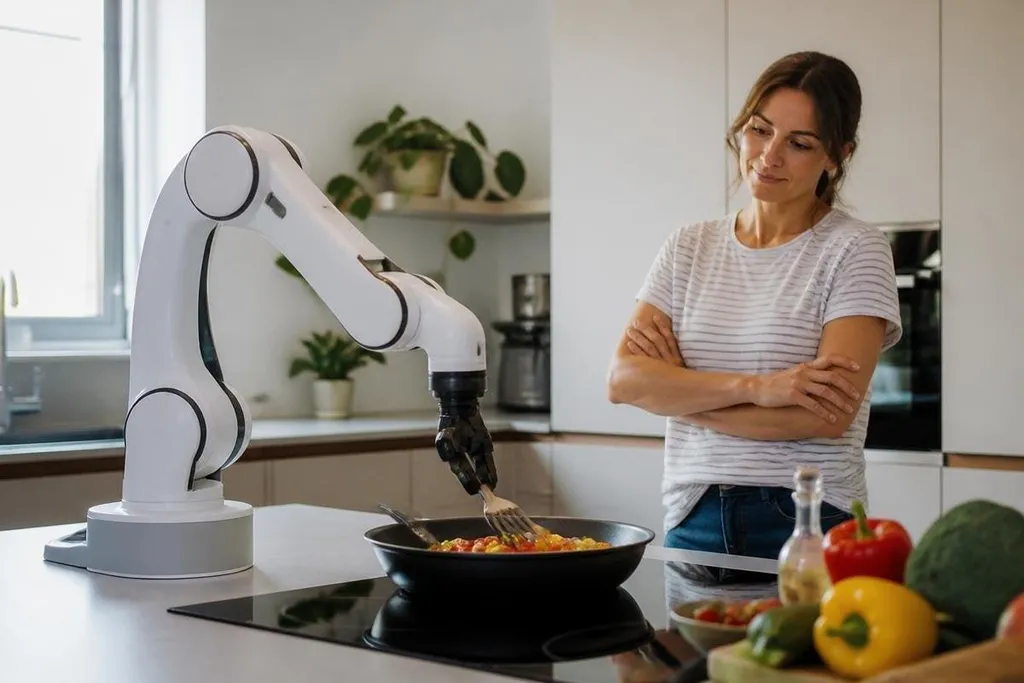
A home cooking robot has to do more than move a pan. It must handle food that changes shape, heat, moisture, and weight while working near people. That makes the kitchen a harder place for automation than a warehouse with fixed shelves.
- Food changes as it cooks, so timing matters as much as movement.
- Cameras can guide motion, but touch sensors help prevent crushed food.
- The first useful systems may assist with prep instead of cooking every meal alone.
The kitchen is a difficult work area
An arm can repeat a path with care, but a potato does not always sit in the same place twice. A soft tomato can split under force, while a hot pan can burn a gripper that works well with dry objects.
That means a cooking robot needs more than an arm and a recipe. It needs a camera to find objects, a force sensor to measure contact, and software that can react when food moves during a task.
Heat adds another problem. Any robot near a stove must manage hot surfaces, steam, oil, and sharp tools without blocking the person using the kitchen. The design also needs a safe stop when someone reaches into its work area.
What a useful robot could do
The first practical systems may take on narrow jobs. One could bring ingredients to a work area, hold a bowl while someone mixes, or move food between a counter and a cooking vessel.
Those jobs matter because they remove repeated hand movements without asking the robot to judge every part of a recipe. A person could still season the food, check its texture, and decide when the meal is ready.
More advanced software could read a recipe as a sequence of actions. It would need to set a cooking time, track the food's position, and adjust the next movement when a step takes longer than planned.
That kind of system would work best with equipment built for it. A pan with a fixed handle position is easier to pick up than a pan left at any angle. Marked storage bins are easier to identify than loose ingredients spread across a counter.
The real limit is reliability
A cooking robot can complete a task in a demonstration and still fail in a home. Kitchens have changing light, cluttered surfaces, narrow paths, pets, children, and people who reach for the same object at the same time.
Cleaning creates another test. Food residue can collect around joints, grippers, and tools. Any part that touches food must be easy to remove, wash, and inspect. A system that needs long cleaning after every meal may leave the cooking work with the owner.
Cost matters too. A robot that needs a new kitchen layout, special cookware, or regular service may suit a new build better than an ordinary apartment. No price or home deployment figure was supplied here, so claims about mass-market availability would be guesswork.
A future home trial would need a named robot, kitchen, task, date, and result before its price could mean much. If a maker supplies those details, a report from Robot 24 could give you a way to check the claim before the limits below decide whether the robot belongs in your kitchen.
What remains unproven
The hard test is not one successful meal. It is repeated work across many kitchens, ingredients, and users without close supervision.
A useful report would need to show the task, the number of attempts, the failure rate, cleaning time, and the cost of ownership. Video alone rarely answers all five points, especially when a clip skips the setup or removes failed runs.
I'd wait for published results from real homes before paying a high price for a robot that promises full meal preparation.
A buyer's checklist
Use these points when a cooking robot reaches your market:
- Defined tasks: Check whether it handles prep, stirring, serving, or a full recipe.
- Food contact: Ask which parts touch food and how they come apart for washing.
- Human control: Find out how you pause the robot and take over by hand.
- Kitchen fit: Measure the required counter space, reach, power supply, and storage.
- Failure records: Look for attempts, misses, recovery steps, and time spent cleaning.
- Total cost: Add cookware, software fees, service, replacement parts, and installation.
The first cooking robot worth buying will probably do a small set of kitchen jobs well, show its failures plainly, and leave the final taste check to you.